
Florida Declares Emergency in 25 Counties as Tropical Storm Isaias Strengthens Into Hurricane
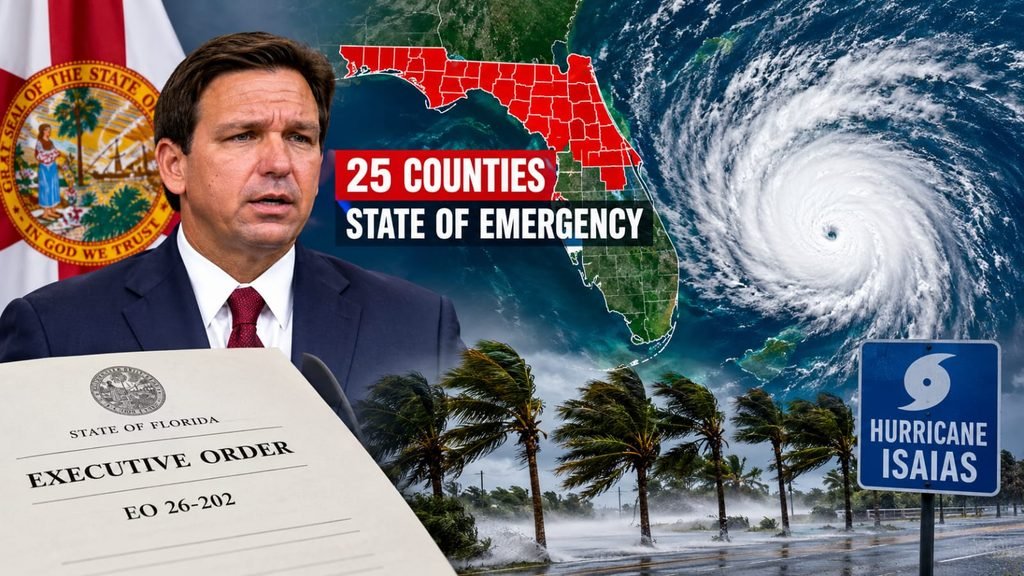
DeSantis Orders State of Emergency Across 25 Florida Counties as Tropical System Becomes Hurricane Isaias
Florida’s governor didn’t wait for the storm to get serious. Ron DeSantis signed an executive order on Tuesday putting 25 counties under a state of emergency, at a point when the system in the Gulf was still only Tropical Depression 9. By late Wednesday it had grown into Hurricane Isaias, the first hurricane of the 2026 Atlantic season.
What the order does
The order is numbered EO 26-202, and its purpose is mostly logistical. Under it, the state’s Division of Emergency Management can move key preparedness supplies and equipment into position in advance. In his statement, DeSantis said the point is to make sure Florida is ready to respond.
He kept his language measured, too. He talked about “potential impacts,” not a storm that was certain to hit. The statement also included a plain request to residents: “Floridians should take this time to get disaster plans in place and ensure their hurricane supply kit is stocked.”
Which counties are covered
EO 26-202 covers these 25 counties: Washington, Wakulla, Walton, Taylor, Suwannee, Santa Rosa, Okaloosa, Madison, Liberty, Leon, Lafayette, Jefferson, Jackson, Holmes, Hamilton, Gulf, Gilchrist, Gadsden, Franklin, Escambia, Dixie, Columbia, Calhoun, Bay and Baker.
Making the list doesn’t tell a resident what their own county will see. What it does say is that the state wants their area prepared while the storm’s path is still unsettled.
How fast things changed
Look at the timing. On Tuesday, when the order was signed, forecasters were dealing with a tropical depression. A day later, the system had been upgraded to a hurricane. Storms can move through those stages quickly, and the order was in place before the upgrade happened.
The WESH story behind this article was last updated at 12:26 a.m. EDT on October 8, 2026. A hurricane doesn’t hold still, so read everything here as of that hour.
What the Hurricane Center is saying
Forecasters at the National Hurricane Center are advising anyone with interests in the Yucatán Peninsula or along the northern U.S. Gulf Coast to keep a close eye on the system’s progress. That reaches well past Florida. DeSantis’s order stops at the state line, but the Hurricane Center’s advice doesn’t.
No landfall prediction comes with that advice. The reporting behind this article also has no forecast track, wind speeds or timeline, so for those details the National Hurricane Center and your local emergency management office are the places to look.
What residents can do now
Nothing complicated. Open the supply kit and note what’s missing. Run through the household plan with everyone at home while there’s no rush. Check official updates once or twice a day. It’s a lot easier to do this while the weather is calm than when conditions are getting worse.
Still unclear
How strong Isaias becomes, where it goes, and whether Florida’s counties see serious effects or the storm bends toward another part of the coast are all open questions, and officials hadn’t confirmed any of it at the time of the report.
What is known is short. Emergency status now applies to 25 counties. State emergency managers can now pre-position resources. A storm that began the week as a tropical depression has now strengthened into a hurricane. And forecasters want the northern Gulf Coast and the Yucatán Peninsula watching it. Official forecasts will fill in the rest as the storm’s track becomes clearer.