A Sanctions Law Meets Its First Test, and the White House Blinks
Trump shelves the Graham Act’s penalties on Russia two days before they were due to start, citing national interest as fuel prices bite
Washington, Oct. 17, 2026
Congress spent more than a year building a sanctions law aimed at Russia’s war economy. It lasted four weeks on the books before the president set its main penalties aside.
On Oct. 16, President Trump signed an executive order using a national-interest waiver to suspend the Graham Act’s penalties, two days before they were to take effect. The law carries the name of the late Sen. Lindsey Graham, and Trump signed it on Sept. 18 after bipartisan votes in Congress. (lawcommentary) (lawcommentary)
What the law required, and what is now paused
Its central aim was to choke off the money Moscow earns from energy. Two provisions do most of the work. One raises tariffs on goods coming from Russia by 500%. The other puts 100% duties on countries that keep buying Russian oil and natural gas. Yet the statute also left the president an exit. If he decides it serves the national interest, he can waive them. He had until Oct. 18 to either impose the measures or use that waiver authority. (Trump Halts Sweeping Russia Sanctions Just Weeks After Signing Them Into Law +2)
Nothing has been repealed, though. The waiver clause is part of the act itself, written in by Congress, so the law is still on the books and only the provisions Trump named are frozen. Sanctions from earlier executive orders haven’t moved. That distinction matters to Trump’s defenders, who can say he used a tool Congress wrote into the law. Critics say it hollows out the law’s purpose. (lawcommentary)
The diesel deal behind the decision
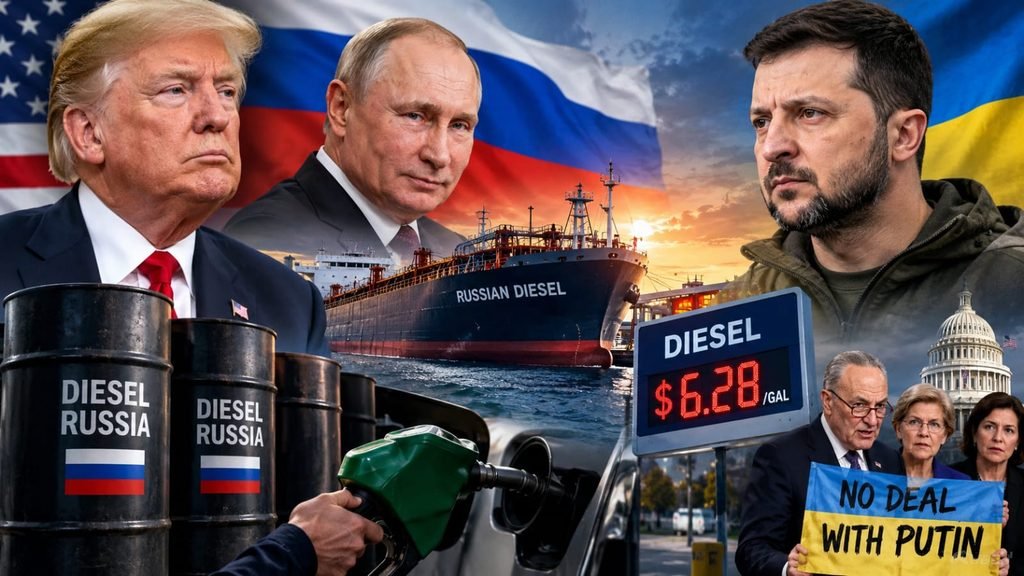
The waiver came a week after a separate, and also controversial, arrangement. On Oct. 9, Trump announced an agreement with Vladimir Putin allowing Russian-origin diesel to reach global markets. The Treasury Department’s sanctions office issued General License 135 the same day, authorizing the sale, delivery and import of Russian diesel through April 7, 2027. (brusselssignal) (kyivpost)
The motive is fuel prices. Diesel hit a record national average of about $6.52 a gallon on Sept. 22, according to Sky News, and was still near $6.23 when the deal was announced. Even the deal’s critics in the Senate acknowledged an “urgent need” to ease energy costs amid disruptions tied to the war with Iran. (heart) (brusselssignal)
Accounts of the fuel volumes don’t agree. One report has Trump saying Russia would immediately supply more than 300,000 metric tons. Another outlet describes a U.S. purchase of 3 million tons spread over the coming months. Sky News reported that Trump spoke of nearly five million tons. Those figures are hard to reconcile, and the volumes the deal will actually deliver remain unclear. Trump has also predicted diesel prices would fall “in record numbers” thanks to the announcement and U.S. control of the Strait of Hormuz. Whether prices actually fall is still to be seen. (Trump waives some Moscow sanctions under Graham Russia-Iran Act +3)
A rare bipartisan rebuke
The diesel arrangement drew objections from both parties before the waiver was signed. On Oct. 13, twelve senators, six from each party and led by Democrat Richard Blumenthal, sent Trump a letter urging him to rescind the deal. The Republican signers included Mitch McConnell, Thom Tillis, Susan Collins, Lisa Murkowski and John Cornyn. They called the deal “a gift to our adversary and a betrayal of our Allies.”
On the economics, they argued Americans would gain little. They wrote that Russian diesel would have a “negligible impact” on American prices while adding to the Kremlin’s revenue. Senate Armed Services Chairman Roger Wicker, a Republican, also questioned whether the arrangement would take effect. (brusselssignal) (brusselssignal)
Other lawmakers were blunter. Republican Rep. Don Bacon called the diesel deal a “grave error,” and Senate Democratic leader Chuck Schumer called it a “deal with the devil.” After the waiver, Rep. Don Beyer, a Virginia Democrat, accused Trump of weakening American pressure on Putin. (kyivpost) (lawcommentary)
Kyiv and Europe watch warily
Ukrainian President Volodymyr Zelensky has been among the most vocal critics. He called the diesel deal a “weak decision” and a gift to Putin. He has also argued that easing sanctions without a durable de-escalation agreement signals weakness, and pointed to the EU’s delisting of two Russian oligarchs, after which he said Russian strikes on civilians intensified. (heart) (kyivpost)
Brussels has signaled it will not follow Washington. EU foreign policy chief Kaja Kallas said suspending sanctions on Russian diesel would hand Moscow more revenue, and that Europe would not ease its own pressure. (brusselssignal)
The administration’s pressure on Kyiv has also changed. Trump recently said Ukraine should get a new president and demanded an end to its strikes on Russian refineries, which he blames for high diesel prices. Zelensky said Ukraine held off striking Russian energy facilities after Trump announced an energy truce. Kyiv has framed those strikes as a response to Russia’s long campaign against Ukraine’s power grid. (kyivpost) (kyivpost)
What remains unclear
Several questions are still open. The first is whether the waiver is meant to be temporary. The Washington Examiner reported that Trump put the legislation on hold indefinitely. The text of the order and its supporting certification to Congress should show whether it sets any conditions or a review date. Some coverage says the order directs the administration to monitor other countries’ purchases of Russian oil and to weigh future tariff action, but that claim rests largely on one legal-analysis outlet, so it should be checked against the order’s text. (washingtonexaminer)
The second is what Congress can do. Opponents can’t really argue the move is illegal, since the law itself allows it. What they have left is political: hearings, public pressure, or a new bill. Nobody yet knows whether the Republicans who signed the Oct. 13 letter will do more than write another one. With midterm elections approaching and fuel prices a live issue, the political calculation is not simple for either side.
The third is whether the diesel arrangement does what the White House says. Analysts and the senators who objected doubt it will move American pump prices much, since diesel is traded in a global market and Russian barrels are only one part of supply. If prices stay high, the administration will have spent the sanctions law’s leverage without the relief it promised.
For Graham, whose name the act bears, the irony is hard to miss. He spent more than a year building support for a measure he described as an economic “bunker buster,” and he built in the waiver clause himself. In earlier remarks, he said the bill would include a presidential waiver to give Trump maximum leverage. The first real use of that flexibility has pointed the other way. (yahoo)