
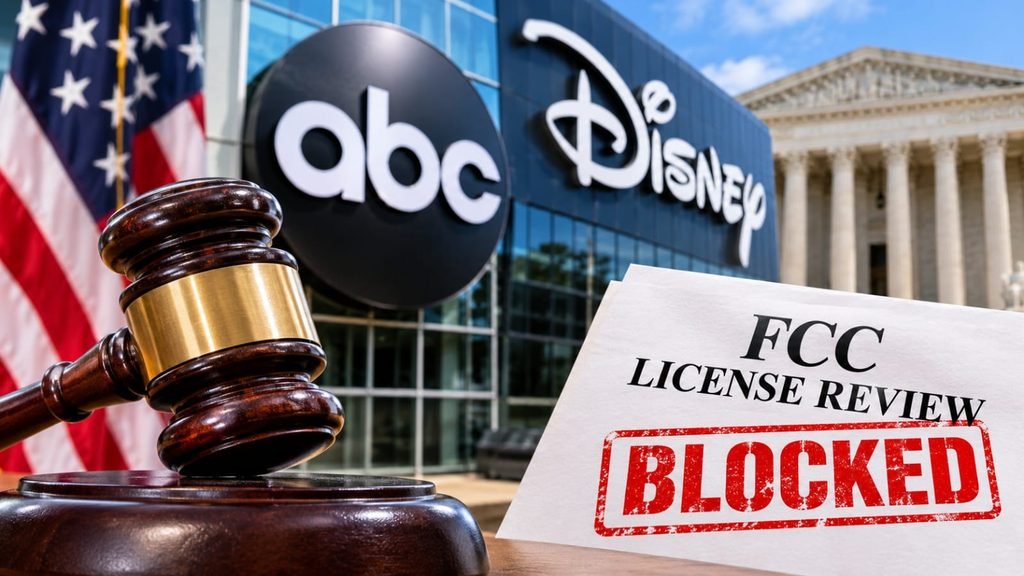
Judge Blocks FCC Review of ABC Station Licenses, Delivering Legal Win for Disney
WASHINGTON, Nov. 25, 2026
A judge has stopped the FCC from reviewing ABC station licenses. ABC has won this round.
Federal Judge Issues Injunction Against FCC Review
A federal judge has put a stop to the review of the licenses for eight TV stations owned by ABC. In a ruling on Wednesday, the judge said Disney will likely be able to show that the government was punishing the network for what it airs.
U.S. District Judge Loren AliKhan granted an injunction. Turned down the agencys request to dismiss the lawsuit. The judge wrote, “This is not a case.” The order is temporary. It is meant to hold things in place while the case goes on. For now, the order takes away one of the administrations tools for pressuring the network.
A Ruling That Points at Carrs Words
AliKhan is a Washington judge appointed by Biden in December 2023. AliKhan concluded that ABC and Disney will likely succeed on their claim of First Amendment retaliation. In a 45-page opinion, AliKhan argued that the risk of losing a broadcast license is so serious that just starting renewal proceedings can make a broadcaster think about what it puts on air. AliKhan was direct about the head of the agency. AliKhan wrote that FCC Chairman Brendan Carr “has taken President Trumps rhetoric as his marching orders.” AliKhan also pointed to signs that the pressure was already changing behavior. According to Varietys report on the decision, AliKhan found that “The View” has stayed away from interviewing candidates for fear of breaking the FCC’s rules. The same source says Jimmy Kimmel posted his interview with Texas Democratic Senate candidate James Talarico on YouTube of risking it on the broadcast network.
How the Conflict Came to Be
The stations at the center of the case are in Los Angeles, New York, San Francisco, Chicago, Philadelphia, Houston, Raleigh‑Durham and Fresno. Reuters says the licenses will not come up for renewal until October 2028. Before this April, the FCC had not ordered a review in than 50 years. Carr told Disney to send in renewal paperwork for all eight stations within 30 days. The order came one day after Trump publicly urged ABC to fire Kimmel. Carr says the review is tied to a FCC investigation into Disneys diversity, equity and inclusion practices. The FCC has said the investigation is about employment practices, not programming. Trump brought the subject up again in July. Trump again called for ABCs licenses to be pulled after the network declined to air a prime‑time speech on elections.
Disney and ABC filed a lawsuit in August. The FCC agreed to give at 48 hours notice before sending the licenses to a hearing. That month, a judge denied Disney’s and ABC’s request for an emergency hearing. Carr said at the time that Carr was not sure Carr should take that step. On October 6, a hearing lasted two hours and arguments were presented. Beth Wilkinson, a lawyer for Disney, told the court that the review had left ABC with a guillotine hanging over it. The government’s attorney Dimitar Georgiev‑Remmel said that comparison was wrong. Dimitar Georgiev‑Remmel said Disney would keep its licenses throughout the process and any court review. The administration also argued that the dispute should have been heard by an appeals court, not a district judge.
The Judge Refused to Grant All of ABC’s Requests
The win was not total. AliKhan declined ABC’s request to bar the FCC from any informal action meant to coerce or threaten ABC over its editorial choices. The Associated Press summarized AliKhan’s reasoning this way: ABC had not pointed to any threats beyond the early renewal proceedings. The FCC is also considering whether “The View” should be exempt from regulations. Broadcasters are required by those regulations to give candidates airtime. Coverage of the order describes it as aimed at the renewal proceedings. Nothing reported far suggests it reaches that inquiry.
Two Different Reactions to the Ruling
According to Variety, ABC News called the decision “a victory for the First Amendment.” The FCC saw it the way. A spokesperson told Reuters that the decision was “wrong on the facts and wrong on the law.” The spokesperson also said the commission expects to prevail and will keep using its authority to make broadcasters meet their public interest duties. Democratic FCC Commissioner Anna Gomez welcomed the decision. Anna Gomez said it brings accountability to an agency she accused of politicizing government power in an effort to control and censor the press.
What Happens Next?
The FCCs statement left doubt about whether the FCC plans to keep fighting the order. As of Wednesday night, the FCC was unclear whether the FCC would file an appeal. Normally, this court would appeal to the United States Court of Appeals for the D.C. Circuit. Because the injunction is preliminary, the underlying question still needs an answer: was the review unconstitutional retaliation? Beyond ABC, why the case matters.
Why the Case Matters Beyond ABC
License revocations are very rare. But critics argue that even the threat can push broadcasters toward programming and invite government influence over decisions, Reuters noted. Carr has claimed that broadcasters are required to act in the interest in order to justify the FCCs actions. Networks, for their part, have First Amendment protection over what they choose to air.
This dispute centers on ABCs eight owned stations, not the network as a whole. The reason is that the FCC licenses stations, not the networks that supply them with programming. Reuters called the case a test of media outlets free-speech rights.
With the FCC signaling the FCC is not finished, the test of free-speech rights is far from over.