
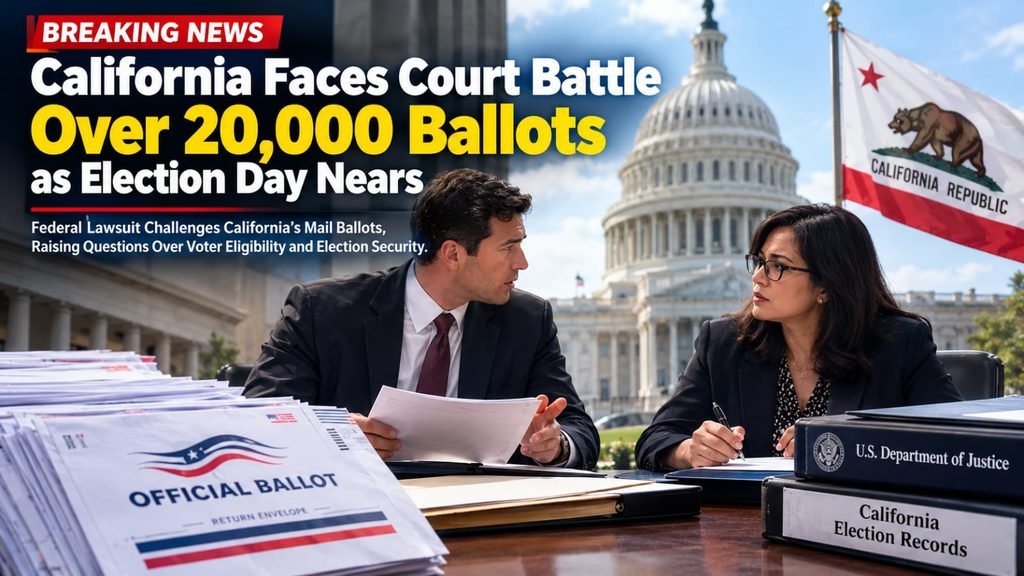
California Faces a Federal Court Fight Over 20,000 Ballots, With Election Day Under Three Weeks Away
With ballots already going out, a federal judge now has to decide whether Washington can force California to hold back votes from people it suspects aren’t citizens, and whether the evidence behind that suspicion holds up.
On Thursday, the Justice Department went to federal court seeking an order that would keep California from counting mail ballots from more than 20,000 registered voters. Its argument: these people are probably not citizens. The suit, filed in the Central District of California, covers ballots for the November 3 midterms. California’s top election official and the registrar of its biggest county aren’t buying it. They’re challenging the evidence, and they’re questioning whether Washington has the power to make this demand at all. (thedailyrecord)
A 48-hour ultimatum
The lawsuit followed a short and tense exchange. Acting Deputy Attorney General Trent McCotter sent letters Tuesday giving state and county officials until noon Thursday to begin reviewing the list and set aside ballots from anyone not confirmed as a citizen. According to Newsweek’s reading of the letter, the department asked officials to segregate those ballots rather than cancel them, and to pause signature verification and tabulation until citizenship was determined. (yahoo)
When the deadline passed, the department sued. Named as defendants are the state, Secretary of State Shirley Weber, and Dean Logan, who runs elections in Los Angeles County. The government’s case leans on the federal law that makes it a crime for a noncitizen to vote in a federal election. Because California sends a ballot to every registered voter, the department argues the state is helping bring about unlawful votes.
How the list was built
The complaint says the names came from a multistage federal review. Newsweek’s reading of the filing goes like this: U.S. Citizenship and Immigration Services ran voter-roll details against its own files and graded each possible match as high, medium or low confidence. Only the high-confidence names moved on to Homeland Security Investigations, which did further checking.
The filing also concedes a weakness. Voter rolls don’t carry complete identifying details, so matching relies on third-party software, and the complaint says low- and medium-confidence matches can reflect incomplete, outdated or mismatched information. The government also says the analysis ran outside the federal SAVE verification program, because to its knowledge California had never submitted its rolls through that system.
The department’s own language shifts as well. It says investigators “reasonably believe” about 20,000 noncitizens are registered, yet it asks the court to hold ballots until citizenship is verified for people it calls “likely” noncitizens. Asked whether the government had definitively established that these voters are noncitizens, the department pointed Newsweek back to the complaint.
California’s objections
Weber’s response, sent Thursday, challenges the data and the timing. She said federal officials never supplied the methodology behind an earlier Homeland Security claim that more than 190,000 California registrants might be noncitizens, though her office asked for it in July. She also said the new list lacked the detail needed to investigate anyone, and that the demands came with less than three weeks left before the election.
Attorney General Rob Bonta seized on the gap between the two numbers. Referring to the earlier 190,000 figure, he asked what had happened to those 170,000. The shrinking number proves less than it might seem. The Justice Department didn’t say whether the 20,000 were drawn from the earlier group, and the difference alone doesn’t show that 170,000 people were wrongly flagged. (Newsweek)
Weber also cited Nevada, where she said Homeland Security first alleged nearly 16,000 potential noncitizens on the rolls but ultimately failed to identify a single one. Newsweek reports that Weber’s letter further raised an October 9 federal court order that she said vacated a Justice Department policy of comparing voter rolls against federal databases and demanding removals based on the results.
The security dispute
Even delivery of the list became a point of contention. Logan said his office received it on a password-protected thumb drive and chose not to open it. He said the device did not meet established security protocols. The Justice Department’s complaint faulted him for a lack of commitment to working with federal officials. The state’s elections office told the Associated Press the password came on a sticky note, according to Newsweek. (kesq)
What the law says
The case turns on a federal rule that Bonta has already invoked. Axios, in the story that prompted this report, noted that federal law restricts systematic voter-roll maintenance within 90 days of a federal election. Congress included the restriction to keep eligible voters from being purged too close to Election Day. Bonta argues the department’s demand could violate it. The government’s theory is different: it argues that federal prohibitions on noncitizen voting override whatever state practices allow those ballots to be counted. (aol)
Legal scholars have been skeptical. Rick Hasen, an election law professor at UCLA, told Reuters he expected the suit to face hurdles. He said he saw no federal authority for the government to tell states which ballots they may send or count, according to Newsweek’s summary.
The department has struggled in court on related questions. In January, a federal judge dismissed its suit seeking detailed voter data on California’s 23 million registered voters. That judge, David Carter, called the request “unprecedented and illegal.” Reporting on the new case notes that it was filed by the deputy attorney general’s office rather than the Civil Rights Division, which has lost several earlier cases over voter registration lists. (The Boston Globe) (yahoo)
Political stakes and the evidence on noncitizen voting
Officials on each side framed the case in sharply different terms. Attorney General Todd Blanche said in a statement that California would have seriously undermined confidence in the electoral system if a court found it responsible. Blanche added that the state had a chance to correct its records and set the ballots aside before the department went to court. Gov. Gavin Newsom, a Democrat, called the suit a desperate attempt to suppress voters. He said California would keep running its election.
Noncitizen voting has been a priority for the administration heading into the midterms, but documented cases are rare. A Reuters-reported investigation published in July found 129 people prosecuted for the offense since the 1996 federal law that criminalized it. That figure counts prosecutions, not necessarily every instance, and it doesn’t settle how many noncitizens might be registered. It does give context for a claim of 20,000.
What happens next
Voting is already underway, which compresses the court’s timeline. As one report put it, a judge must decide whether to grant the request before California counts its ballots. The department seeks both a preliminary and a permanent injunction. The court will likely have to weigh the risk that ineligible ballots are counted against the harm of delaying or withholding ballots from voters who turn out to be citizens.
Much depends on evidence the public hasn’t seen. The sticking point is whether a matching process that allows for mismatched and outdated records can justify holding the ballots of thousands of people before anyone confirms who they are. The government says it can. California says it hasn’t been shown