
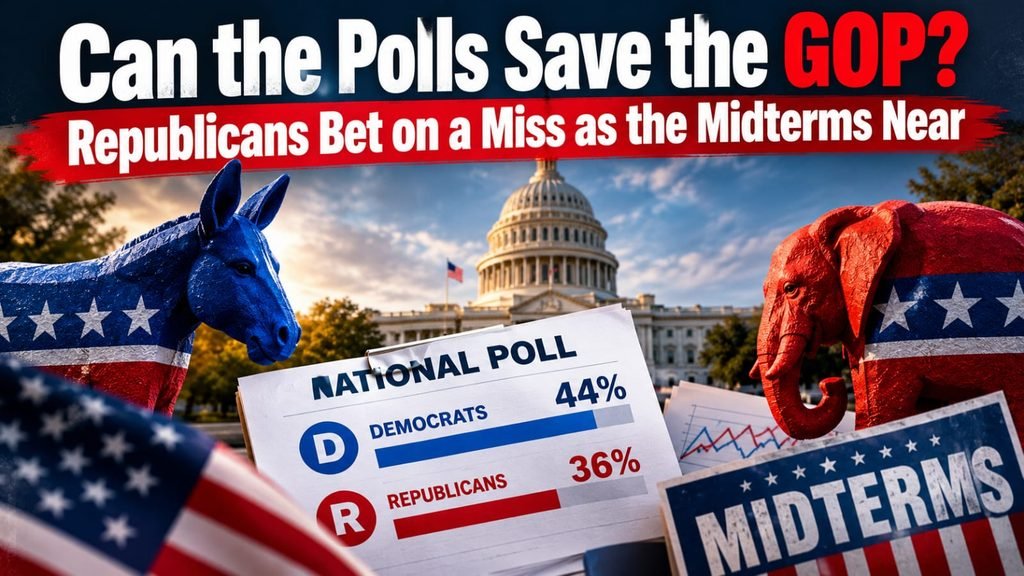
Can the Polls Save the GOP? Republicans Bet on a Miss as the Midterms Near
With about three weeks until Election Day, Democrats lead in nearly every national survey. Republicans are pointing to recent history in hopes the numbers are wrong.
Three weeks before the November 3 midterms, Republicans are leaning on an argument that has less to do with winning voters than with doubting the numbers: that the surveys showing them behind are flawed. The argument has real roots in recent elections. Whether it holds up is another matter.
A lead that has been growing
A Pew Research survey of registered voters this month put Democrats ahead on the generic congressional ballot, 44% to 36%. Aggregators show a similar picture. One roundup of the polls described Democrats leading by roughly nine points, with Nate Silver’s tracker at D+8.9 as of October 7. That would be the party’s best showing of the cycle. (politicalwire) (political)
Context matters here. Because of how district lines are drawn, Democrats have usually needed a bigger national margin than Republicans to win the House. Analysts at G. Elliott Morris’s Strength In Numbers estimated that an eight-point advantage, the size of the 2018 “blue wave,” would translate to about 237 House seats. A lead near that size puts Democrats in majority territory, at least on paper. (gelliottmorris)
The economy is not helping
The political weather is unfriendly to the party in power. Wednesday’s numbers from the Bureau of Labor Statistics were not kind. September saw prices go up 0.6 percent, and gasoline, which leapt 9.1 percent, did most of the heavy lifting. Compared with a year ago, the inflation rate is 3.7 percent. In August it was 3.4, per ABC News. That is far above the 2.4 percent seen in February, before the Iran war started. (bls) (abcnews)
Then there’s the pump. AAA says a gallon of gas now averages $4.33 nationwide, against $2.98 on February 27, a jump of roughly 45 percent. Core inflation, the version that leaves out food and energy, is lower at 2.6 percent for the year. But paychecks aren’t keeping pace either: the same reporting found wages rising about 3 percent annually, and they haven’t outrun prices since March. Sluggish September hiring added to the unease. (CNBC) (NBC News)
Why Republicans think the polls could be wrong
Republicans have a reason for this hope, and it isn’t imaginary. The polls underestimated Trump in 2016. They did it again in 2020, and again in 2024. After that last race, one analysis looked at the seven battleground states and found the averages ran too low on him in every single one, by 0.9 to 2.7 points. The 2020 polling review floated one explanation: his backers may simply be less willing to answer a pollster’s call. If that problem persists, a Democratic lead of a few points in a key Senate state could be smaller than it looks. (thefulcrum) (The Boston Globe)
This is where the margins get thin. The Senate is currently 53-47 in the Republicans’ favor. For Democrats, Newsweek explains, the target is a net gain of four seats for a real majority. Three seats only gets them to a 50-50 split. Fox News currently lists six toss-up races: Michigan, Iowa, Texas, Ohio, Maine and Alaska. It also reported that Cook Political Report moved Texas and Iowa into the toss-up column. When races sit that close, an error of two or three points can decide who controls the chamber. (Newsweek) (Fox News)
The counterargument
There is a significant complication for the “polls are wrong” theory, and it comes from the last midterm. 2022 is widely remembered as one of the better years for pollsters; the Boston Globe described those midterm polls as among the most accurate in years. And RealClearPolling found that in that year’s swing-state Senate contests, surveys actually overstated Republican support by 3.7 points on average. In other words, the miss ran in the opposite direction from the one Republicans are hoping for now. (The Boston Globe) (realclearpolling)
One explanation offered by an analysis of the 2024 data is that midterm electorates tend to be smaller, more habitual and made up of higher-propensity voters, who are easier to model. Trump’s own turnout operation also appears to have mattered in 2024. Pollsters cited by NPR noted that late-deciding voters broke heavily for him, and that his campaign worked to bring out people who vote less often. With Trump not on the ballot this year, it is unclear whether those voters will show up. (uspollingdata) (NPR)
There is also the matter of what a polling miss would mean. Errors of the size seen in 2024 would narrow Democratic leads, not erase them. A nine-point national lead is a lot of cushion to overcome, though state polls, where the Senate will be decided, carry more uncertainty than national ones.
Where the uncertainty lies
The polling world is shifting too, and not in a single direction. Fewer people respond to surveys each year, so firms now blend phone, text and online methods, each with its own weak spots. Some Republican strategists say text surveys lean toward younger, more liberal respondents. Pollsters try to correct for that by weighting their samples, though people in the field don’t agree on how well that actually works.
Race-specific developments add noise. In Maine, Newsweek reports, Democrats picked former state Senate President Troy Jackson as their nominee after Graham Platner exited the race over a sexual assault allegation that he has denied. Developments like that can move a tight contest in ways earlier polls never registered. (Newsweek)
What to watch
For Republicans, the hope is not that the polls are slightly off but that they are off in a very specific and favorable way. That has happened before, but it has also failed to happen, as in 2022. Analysts caution that no one can say in advance which kind of year this will be.
A few markers will say more than any single poll. One is whether gas prices ease before Election Day, which would take some pressure off the party in power. Another is whether early-vote and turnout data suggest the electorate looks more like 2024’s or more like 2022’s. And the final week of state-level Senate polling, especially in Texas, Iowa and Alaska, will show whether the supposedly red-leaning terrain is truly in play or merely competitive on paper.
For now, the numbers favor Democrats, and Republicans are left to hope those numbers are wrong. History says that is possible. It does not say it is likely.