
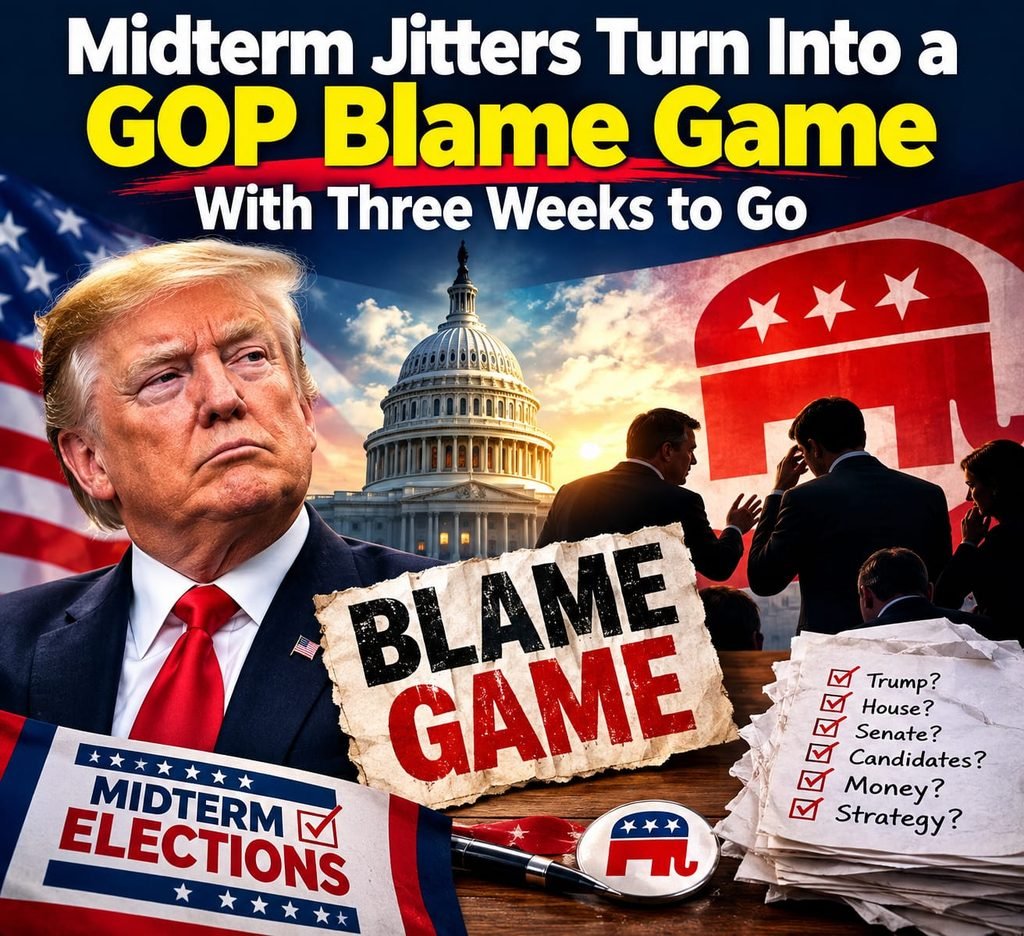
Midterm Jitters Turn Into a GOP Blame Game, With Three Weeks to Go
Republicans insist they can hold Congress. Privately, many are already sorting out who gets the fault if they can’t.
WASHINGTON, Oct. 19, 2026
With Election Day about two weeks and a bit away, Republicans on Capitol Hill and in campaign headquarters are splitting over how to read their own prospects. Publicly, party leaders talk about holding both chambers. Behind the scenes, according to multiple news accounts, a quieter argument is under way about who would be to blame if November goes badly.
A president who sees it coming
Donald Trump has acknowledged the risk himself. At a Tennessee rally on Oct. 10, he said Republicans would blame him if they lost the midterms, and that he would get no credit if they won. NBC News reported that an average of polls puts his approval at 38%, against 59% who disapprove. (NBC News) (NBC News)
It is not a new worry for him. In January, Trump told House Republicans at a party retreat that Democrats would impeach him a third time if they took control of Congress. (Fortune)
The White House rejects the gloomy framing. One White House official told CNN that the panic was “unwarranted” and “unfounded,” and spokesman Davis Ingle called Trump the party’s best messenger. A senior Republican National Committee official also argued that strategists were writing off the GOP too early. (CNN) (CNN)
What the forecasters see
Outside analysts are less optimistic. The Cook Political Report recently moved 15 House races toward Democrats, all in one direction, and now projects a Democratic gain of five to 15 seats. That would be enough to flip the chamber. The Senate looks closer. Cook calls control “on a knife’s edge,” likely to turn on seven toss-up races, with Democrats needing to flip four Republican-held seats while defending their own. (kmph) (kmph)
Cook’s forecast is a projection, not a result. Midterm outcomes have surprised forecasters before.
Where Republicans point fingers
The complaints fall along several lines, and they often contradict one another.
House versus Senate. Politico reported that House Republicans are frustrated that the Senate side let a favorable map slip and fielded weak candidates in key states. Senators, in turn, place the responsibility on Trump, according to three GOP senators and a national operative. The complaint is that he pushed out stronger incumbents and then backed flawed nominees. (yahoo) (yahoo)
The money squeeze. A national GOP operative working on House races told Politico that cash expected for House contests is being pulled into Senate fights. The shifting map backs up the complaint. The Associated Press reported in early October that the Senate Leadership Fund, the top GOP Senate super PAC, was pulling back in North Carolina and putting money into Kansas. It had planned to spend $18 million in North Carolina over the next month, and reserved nearly $8.2 million for Sen. Roger Marshall in Kansas. CNN later reported at least $10 million going to Kansas. (Republicans Plunge Into Raging Blame Game Ahead of Midterms Wipeout +3)
That is a notable place to be spending. Kansas hasn’t elected a Democratic senator since 1932, and Trump carried it by nearly 16 points in 2024. One data aggregator reported that Decision Desk HQ’s polling average has Marshall and Democrat Hamilton even. That is a single average and should be read with caution. (kctv5) (defirate)
The Texas question. Few races capture the internal argument better. Ken Paxton won the GOP nomination by beating Sen. John Cornyn in a May 26 runoff. Polling since then has been tight. A New York Times/Siena survey in June had Paxton and Democrat James Talarico tied at 47%. A Texas Southern University poll in September had Talarico ahead 47% to 46%, with a Libertarian candidate taking 3%. A July Texas Public Opinion Research poll gave Talarico a larger lead, 45% to 40%. Pollsters stress that these margins sit within the polls’ error ranges. The Texas Politics Project’s Josh Blank said the polling reflects a competitive race. Texas has not elected a Democrat statewide in more than three decades. (Shock poll: Talarico ties Paxton in Texas Senate race, threatening GOP stronghold +4)
The kitchen-table problem
Underneath the finger-pointing is an argument over what is actually hurting the party. Sen. Bernie Moreno of Ohio offered one answer, telling reporters that if Democrats win both chambers, gas prices would be the reason, not the quality of their candidates. (The Daily Beast)
CNN’s analysis suggests the problem is wider. It found that voters who tie higher costs to Trump’s policies pose a particular danger to Republicans, who have voted nearly in unison for his positions on tariffs and the Iran war. Senate Republicans voted eight times to back the tariffs and 14 times to back the war. CNN also reported that weeks of polling show Republicans on track to lose the House, with voter anger over the war and living costs at the center. (Voters frustrated with Trump’s agenda blame the GOP +2)
That sets up a vulnerability for incumbents. Candidates who cannot easily distance themselves from votes they cast will struggle to run against the policies voters are complaining about.
Cracks inside the party
Not every complaint is happening behind closed doors. In August, GOP senators told The Hill that Trump’s repeated criticism of the Senate was making their jobs harder. Sen. Lisa Murkowski of Alaska said his attacks on the chamber “doesn’t help.” A White House spokesperson pushed back and pointed to Trump’s record on immigration and public safety. (Senate GOP sees Trump as potential liability in 2026 midterm election +2)
More recent reporting suggests the mood among House members has darkened. One House Republican told a reporter that members were “running for our lives,” while another said the president’s numbers were dragging down candidates. (ibtimes)
What to watch
Three things will show whether the blame game is a sideshow or a preview. The first is whether spending keeps shifting from reach states into states Republicans assumed they would win easily. The second is whether Trump publicly assigns blame before votes are counted, as he has done at times with other Republicans. The third is whether more incumbents in tight races choose to distance themselves from the White House in the final stretch.
Republicans still have reasons for hope. Midterms are decided district by district, forecasts can miss, and turnout is hard to predict. Several of the tightest contests, including Texas and Kansas, are polling within the margin of error, so there is no settled outcome yet. But the early finger-pointing reveals something about the party’s own expectations. People who feel confident of winning rarely begin assigning fault this soon.