
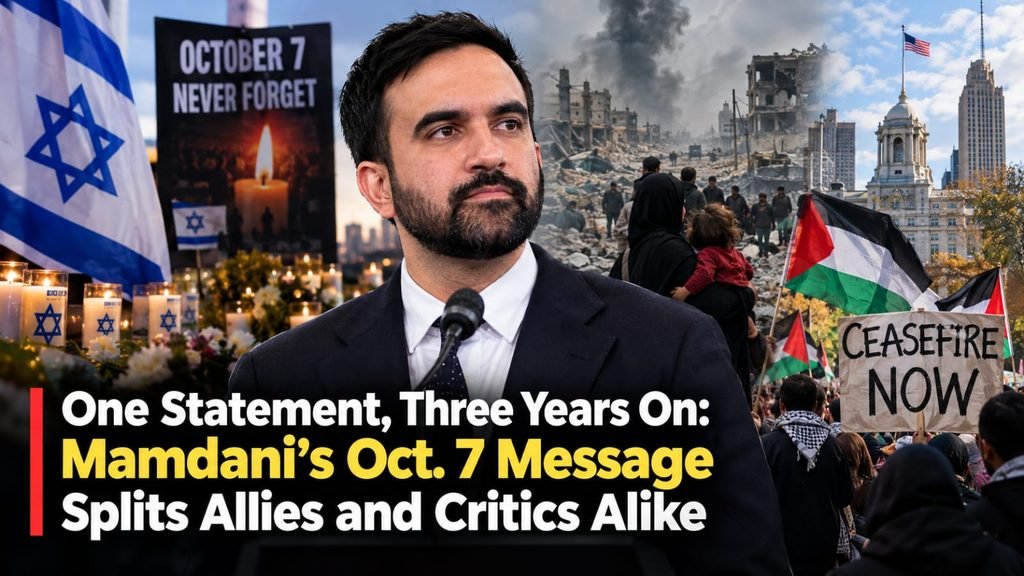
One Statement, Three Years On: Mamdani’s Oct. 7 Message Splits Allies and Critics Alike
New York’s mayor mourned Israeli victims and condemned the war in Gaza in the same short statement. Both his critics and some of his own base are unhappy.
New York City Mayor Zohran Mamdani issued a roughly 200-word statement on Wednesday marking three years since Hamas attacked Israel. It was his first anniversary as mayor, and it mourned the Israeli victims and the 251 hostages before turning to condemn Israel’s war in Gaza. The reaction came quickly from Jewish organizations, Israeli officials, fellow Democrats and, from the other direction, some left-wing activists.
What the mayor said
Mamdani called the day profoundly painful for many New Yorkers and said Hamas killed more than 1,100 Israelis and abducted 251 others. He then widened the frame. Hamas’s attack, he wrote, was not where the suffering started or stopped. From there he turned to Gaza, calling Israel’s campaign an “ongoing genocide” and saying it has killed more than 74,000 Palestinians, over 21,000 of them children. He accused Israeli forces of bombing ambulances, hitting journalists and choking off food at the border.
Those numbers come with context. CBS News noted that the 74,000 figure comes from Gaza’s Hamas-controlled health ministry. The word “genocide” is also contested. Mamdani and many human rights advocates use it, while Israel and many of its supporters reject it, so readers should treat it as the mayor’s characterization rather than settled fact.
The backlash
The most pointed criticism focused on what the statement left out. ADL chief Jonathan Greenblatt zeroed in on a single word: Jews. Mamdani, he wrote, never used it, and he accused the mayor of using a day set aside for mourning as a weapon. Israel’s U.N. ambassador, Danny Danon, told the New York Post that Mamdani was trying to “hijack” the day. In his view, it was like turning the 9/11 anniversary into a critique of America. AIPAC called the statement a “disgraceful moral failure.” The Republican Jewish Coalition also condemned it, accusing the mayor of spreading Hamas propaganda.
Democrats joined in too. Rep. Debbie Wasserman Schultz called the statement “obscene” and accused Mamdani of refusing to condemn Hamas. Democratic Majority for Israel said it diminishes the gravity of the day and disrespects the victims. Andrew Cuomo, whom Mamdani defeated, also criticized him. Former Senate candidate Alex Vindman said the statement did a disservice to Democrats courting moderate and independent voters.
Not every Democrat piled on. Brad Lander, the Democratic congressional nominee and a Jewish ally of the mayor, did not criticize him. On his Substack, Lander wrote that remembering Oct. 7 and recognizing the huge gap in power between Israelis and Palestinians are not mutually exclusive. Julie Menin and Mark Levine, two New York officials, called for keeping attention on the victims. Neither went after the mayor by name.
A contrast in tone
The statement stood out against those from other officials. Gov. Kathy Hochul called Oct. 7 the deadliest day for Jewish people since the Holocaust.
Hochul went further than words. She ordered flags on state buildings lowered to half-staff and had landmarks across the state lit in yellow. Jeffries, the House Democratic leader, didn’t shy from naming Hamas as the force behind the attack, describing its members as terrorists bent on destroying Israel. But in the same breath he acknowledged the Palestinian lives lost and the wreckage in Gaza, a balance Mamdani’s critics say his own statement never struck. Attorney General Letitia James used the phrase “Hamas terrorist attacks,” a term some observers noted Mamdani did not use.
That difference matters because Hochul has been something of an ally to the mayor. Two weeks ago, she said Prime Minister Benjamin Netanyahu was not telling the truth in a video that falsely accused Mamdani of supporting Hamas. Defending him against that charge is not the same as endorsing Wednesday’s statement, and her office chose a very different tone.
Pressure from the left
Mamdani is also under strain from his own flank. Several chapters of Young Democratic Socialists of America planned to protest outside City Hall, arguing that he has repeatedly capitulated to “Zionist pressure.” The mayor declined to comment on the demonstration.
The tension showed at a peace vigil in Union Square. Activists crowded in beforehand, and police erected barricades and a buffer zone. The crowd chanted that the mayor couldn’t hide, and drumming and chanting continued outside the barricades. The group hosting the vigil, Israelis for Peace, said Mamdani had asked to attend but would not speak. Attendance itself was a gamble. A poll published Wednesday found 64% of Jewish voters in the city preferred that he skip any event marking the massacre.
The larger backdrop
None of this arrived in a vacuum. Mamdani’s sharp language about Israel, his unwillingness to define antisemitism, and his support for pro-Palestinian protests held outside synagogues had already left parts of the Jewish community wary of him before Wednesday. The Israeli consulate, which had invited Mamdani to view footage of the attack in the days before the anniversary, called his statement a disgrace.
Mamdani’s supporters would likely say he is being consistent. He has long maintained that criticizing Israel’s government is distinct from antisemitism, a position CBS News described him as having defended for years. Critics counter that a mayor of the city with the largest Jewish population outside Israel carries a particular duty on a day like this. Both arguments are fair game in a democratic debate. Neither can be settled by a statement.
What comes next
Whether this blows over or sticks is the open question. A poll released this week found Jewish New Yorkers faulting him on antisemitism, even as they backed his police commissioner. On the other side, activists who helped carry him into office are saying he hasn’t done enough for Palestinians. Right now he’s being pulled from both directions.
He has shown little sign of softening his language for either group. Wednesday’s statement suggests he believes mourning and condemnation can coexist in one message. Plenty of New Yorkers on both sides disagree.