
Every American was affected by a router issue. Flight.
The bill is up for debate in Washington right now.
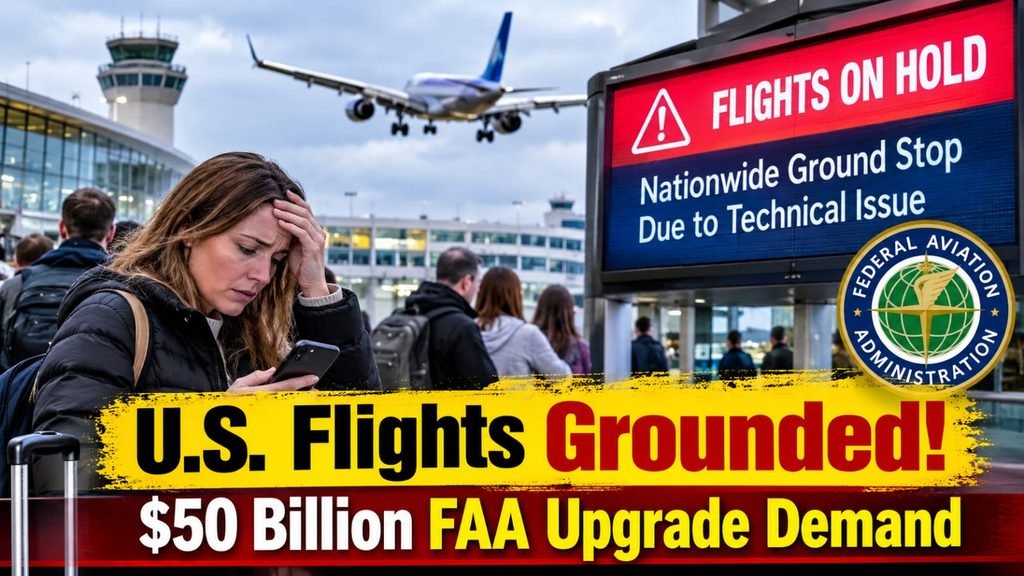
A ground stop that lasted longer than four hours has resulted in a dispute over who is responsible for the deteriorating air traffic network in the United States and who should pay to replace it. The Federal Aviation Administration halted every departing flight in the country on Friday afternoon.
By Sunday, the argument over why had grown almost as tangled as the airline schedules it left behind. Transportation Secretary Sean Duffy used a round of Sunday interviews to renew his call for $50 billion and to blame decades of underinvestment. Democrats pushed back that Congress has already given the administration what it asked for.
After the system that sends pilots their pre-flight notices failed in 2023, it was the second nationwide ground stop since the Sept. 11 attacks. It was also the longest since 2001, according to one count.
Friday Evening
According to Duffy, controllers began observing unstable communications and radar shortly after 3:30 p.m. Eastern, and the FAA stopped departures at 3:54 p.m. At that point, approximately 3,500 aircraft were in the air. Duffy said all of them landed, and the order was lifted at 8:15 p.m.
As many as 17 of the country’s 22 air traffic control centers were affected, but none were completely offline, FAA Administrator Bryan Bedford stated on Saturday. Yahoo News was informed by the head of the controllers’ union that some aircraft’s contact was disrupted during the outage. After more than four hours, the nationwide ground stop was lifted, with the Trump administration blaming outdated, overloaded technology.
What the Investigators Discovered
According to Duffy, a contractor, L3Harris, was switching old copper wire to fiber at a remote FAA location while replacing a router. El Dorado, Arkansas, served as the location. When the new router there was turned on, a router installed about three weeks earlier in Amarillo, Texas, also began flooding the system.
CBS News reported that the flooding went on for about 45 minutes before the FAA could work out what was behind the instability. Once both devices were disconnected, the communications problems eased. The FAA has since turned off the broadcast feature on all 69 routers of that type.
Who Is Responsible Remains Unsettled
Duffy has said L3Harris “didn’t meet the moment.” Hewlett Packard Enterprise, which owns router maker Juniper Networks, says the device functioned as its installer configured it and did not fail. L3Harris says it is supporting the FAA’s investigation.
According to Bedford, the possibility of a faulty router, an incorrect configuration, or an installation error is being considered. Duffy says the routers are being examined at an L3Harris lab in Florida, with the FBI and other law enforcement partnering on the review.
Officials Claim to Have Found No Evidence of Wrongdoing
Homeland Security Secretary Markwayne Mullin said Friday night that nothing pointed to a cyberattack, though he stopped short of ruling one out. Saturday, Bedford stated that detectives had observed “zero evidence of anything nefarious.” Air Space Intelligence, the vendor behind the FAA’s new SMART tool, said its software had no role in the stop.
The explanation of aging equipment is complicated by a single aspect. The routers under suspicion are new units that were plugged into a decades-old network, which is the layer Duffy says most needs replacing.
The Argument Over Money
Duffy wants $50 billion from Congress for new telecommunications, software, and hardware. Before Friday he had been asking for about $30 billion, on top of the $12.5 billion Congress approved last year. Duffy says none of that $12.5 billion can pay for a new telecom architecture, and that it is on track to be spent by the end of 2028. On Friday night he warned that without the money, “you will have more of these.”
Democrats say the department is asking for more before spending what it has. Sen. Chris Van Hollen of Maryland called it “really rich” to hear Duffy point at Congress, noting that Republicans wrote the $12.5 billion into last year’s budget law and saying only a third of it has been spent. Van Hollen also said he would support whatever level of funding is truly needed, as long as administration officials come to Congress and justify the request. Rep. Laura Friedman argued the money exists and the real issue is priorities, noting that the same Republican bill gave immigration enforcement $75 billion.
Republicans have largely echoed Duffy. President Trump posted on Truth Social on Sunday that Congress must approve the money to build a new system. His comments also blamed the Biden administration for worsening an old, broken system. House Speaker Mike Johnson said Saturday he would add FAA funding to an upcoming legislative package. At Friday’s White House briefing, Duffy was asked why the funding had not been secured with Republicans controlling both chambers.
House Democratic leader Hakeem Jeffries called the outage an “unprecedented breakdown,” and Sen. Maria Cantwell, the ranking Democrat on the Senate Commerce Committee, said the panel will look at how planes communicate over primary and backup frequencies.
The Weekend Fallout
FlightAware recorded 9,138 cancellations in the United States on Friday and 6,693 on Saturday, significantly more than Bedford had anticipated for Saturday. About 1,500 more flights were canceled Sunday as airlines moved planes and crews back into position. JetBlue scrapped 27% of its Sunday schedule and American about 10%.
Bedford said airlines expected full schedule integrity by close of business Sunday, while Duffy said Sunday that things would probably be fully normal on Monday. He has said he expects the system to be operating normally heading into Thanksgiving travel, now less than two weeks away.
The router tests were still under way on Sunday. Until they finish, whether this was an installation mistake, a configuration problem or a hardware flaw stays open, and so does the question of whether Congress will sign off on a $50 billion rebuild.