
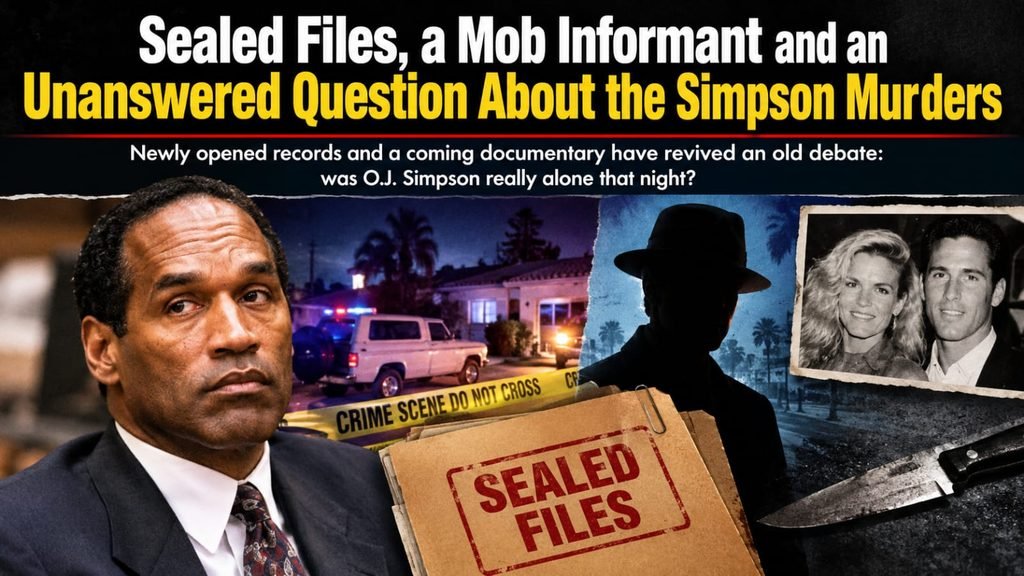
Sealed Files, a Mob Informant and an Unanswered Question About the Simpson Murders
Newly opened records and a coming documentary have revived an old debate: was O.J. Simpson really alone that night?
Three decades on, the Simpson case still refuses to stay buried. On Sunday, The New York Times reported that court records, unsealed only recently, show a federal informant had given investigators information about the 1994 killings of Nicole Brown Simpson and Ron Goldman outside her Los Angeles home. A streaming documentary arriving in December will put the same question in front of a much bigger audience: was Simpson alone?
What happened
Brown Simpson and Goldman were killed on the night of June 12, 1994. Simpson, the ex-NFL star turned actor, was put on trial for both killings. Cameras carried most of the proceedings, and in October 1995 he was acquitted. A civil jury later came to a different conclusion and held him responsible for the deaths. Simpson died in 2024.
One feature of the case never went away. The weapon, a knife, was never found. Over the years, tips have sent police chasing blades that turned out to be irrelevant. In 2016, for example, detectives determined that a knife turned in as possible evidence was not the weapon used. That knife had been described as found at Simpson’s former property, though its origin story was third-hand at best, according to the police captain involved. (NPR)
The informant
The Times reports that the records center on Joseph “Joey” Ippolito, a convicted drug trafficker with reported mafia connections. According to the newspaper, he escaped from a Florida prison about a month before the murders and went to Los Angeles, where he had once run a well-known restaurant. His brother told the Times that Ippolito was close to Al Cowlings, Simpson’s lifelong friend.
Cowlings is the man who drove the white Bronco in the slow-speed chase that captivated the country days after the killings. He was charged with aiding a fugitive, but prosecutors later declined to pursue the case for lack of evidence. (Romper)
After Ippolito was recaptured, the Times reports, he became a cooperating witness. Prosecutors in New York later described the information he provided on organized crime as valuable, and they urged a federal judge to go easy on him at sentencing. The newly unsealed material, per the Times, also shows he told authorities what he knew about Simpson, including where the weapon had supposedly gone and how Simpson had tried to evade arrest.
The newspaper says the account is supported by a federal court memo and a sentencing transcript, and that several people confirmed Ippolito’s cooperation independently: a federal prosecutor, a former U.S. marshal, a former Drug Enforcement Administration agent and an official who worked on the murder prosecution.
The brother’s claim
The most explosive element comes not from the documents but from a relative. Ippolito’s brother told the Times this year that Joey’s involvement went further than passing along rumors. By his account, he personally helped dispose of a bag holding a heavy object in the hours after the killings.
That is a significant assertion, but it is also the type of claim that deserves caution. It is one man’s recollection of events from decades ago. Ippolito, who the Daily Mail reported died in 2006, cannot be questioned about it. No physical evidence has been presented to tie the bag to the crime, and the records do not establish what the object was. (Yardbarker)
What it does and doesn’t prove
Careful readers should separate what the records show from what they might suggest.
As the Times describes them, the documents show that an informant connected to Simpson’s circle talked to federal agents about the case, and that those agents trusted him on other matters. What they don’t show is that his information about the weapon was accurate, or that anyone other than Simpson was involved in the killings. Even a good tip is only a lead, and an informant who proved useful on one subject can be unreliable on another. Remember, too, that jurors in 1995 sat through a case that leaned heavily on blood and DNA evidence, and they acquitted all the same.
The idea of an accomplice is not new either. It has circulated since at least 2007, when Simpson’s much-criticized book If I Did It appeared. MediaPost noted that the accomplice speculation stems largely from that memoir. (MediaPost)
I couldn’t find confirmation of the underlying records from any other major news outlet. A few smaller sites have summarized the Times story, but they simply repeat it and add no reporting of their own, so they shouldn’t count as independent verification.
A documentary joins the conversation
The timing is notable. Peacock has announced a two-part documentary, OJ’s Accomplice, set to premiere in December 2026 and produced by Ample Entertainment. The network says the film features interviews with Kato Kaelin, the houseguest who became a household name during the trial, and with Nicole Brown’s sister, along with eyewitness accounts it describes as never heard before. Its stated premise is that members of Simpson’s inner circle may have been present that night. (BroadwayWorld)
The Daily Mail, citing unauthorized clips it viewed, reported that the film names Ippolito and includes two of his brothers. I could not verify that independently, and the film has not been released, so its evidence is untested. Promotional language such as claiming to “challenge the dominant narrative” is a marketing pitch, not a finding.
The open questions
Several things remain unclear, and they matter:
When did prosecutors learn what? According to the Times, federal officials passed the informant’s information to Los Angeles prosecutors. When and how completely they did so, and whether it could have changed anything at trial, is still unresolved.
Is the weapon claim checkable? With no knife ever recovered, a tip about where it ended up is nearly impossible to test, and trying to search for it three decades on would run into major obstacles.
Is a reopened investigation realistic? Simpson is dead, and the legal avenues for new charges against anyone else are uncertain. No law enforcement agency has announced a new investigation, based on what I could find.
Why it still matters
The Simpson case remains unusual because both the public and the legal system reached such different verdicts. Whatever you make of the acquittal, the families of Brown Simpson and Goldman have gone a generation without a definitive account of what happened. Fresh claims, especially ones that emerge from sealed records and a relative’s testimony, can tear that wound open again even when they don’t amount to proof
.
For now, here’s what we can say: an informant gave authorities information, officials considered him generally reliable, and a relative has made a startling claim about his part in all this. What would turn that into an answer is evidence that can be tested, and so far none has been shown publicly.